MileWage: I Retired Comma and Rebuilt It Around a Server I Own
Comma kept a delivery driver's data on the phone. MileWage moves it to a home server reached over Tailscale. Here is what broke in Comma, what I changed in eight days and about 450 commits, and what is still untested.
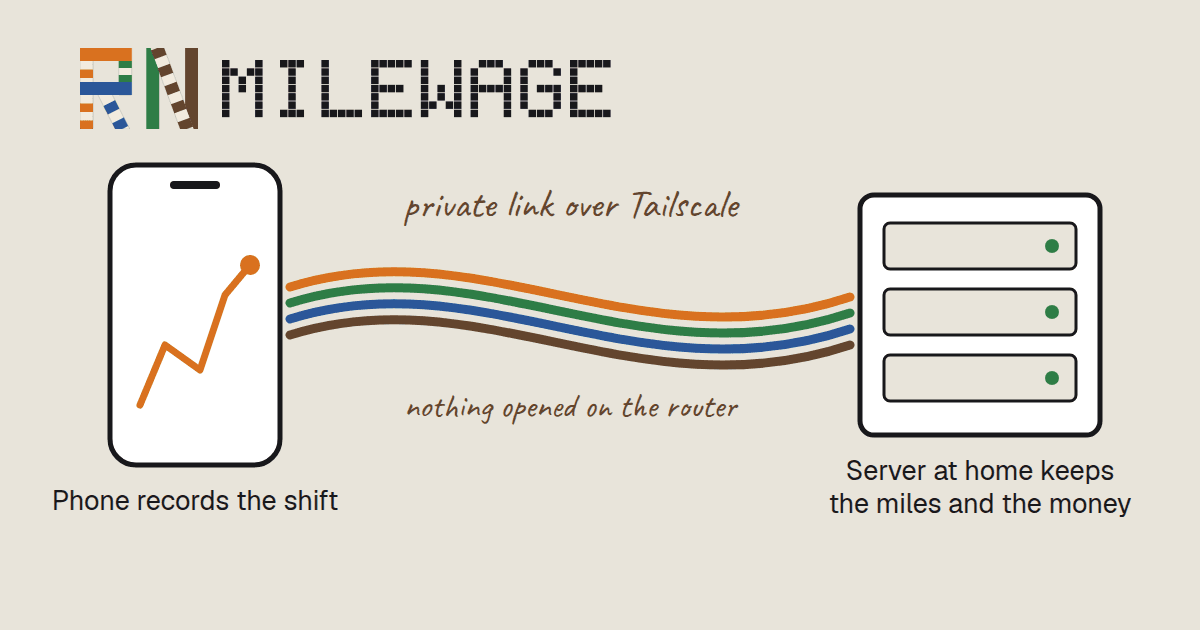
MileWage is a self-hosted mileage tracker for delivery and ride-hail drivers. An Android app records the shift, and a server on a machine I own keeps the miles and the money. It replaces Comma, which I archived this week.
Version 0.3.0 is public under the AGPL. It has not recorded a real shift on a real road yet, and that caveat is in the README as well.
- Source: github.com/raiz-toff/Milewage
- Project page: MileWage
Comma hit a wall that a browser cannot get past
Through 2025 I logged every DoorDash week in a Google Sheet: hours, deliveries, pay, tips. The sheet did the sums, but it only knew what I typed in.
I turned the sheet into a small site called Macadam, with a server and a database. Then I rebuilt it to run entirely in the browser with no account. Macadam became Comma.
As a web app, Comma could not track a shift. A browser cannot record GPS in the background, so the phone stopped logging when the screen turned off. I rebuilt Comma as a web app plus a phone app and got sync working between them.
I used that version for more than six months and kept a list of what was good and what was bad. MileWage is built from that list.
The server is now the single source of truth
Comma treated the phone as the home of the data and synced copies around it. MileWage reverses that.
| Comma | MileWage | |
|---|---|---|
| Where the data lives | On the phone | On a server you own |
| Phone app | Expo and React Native | Native Kotlin, Jetpack Compose |
| How the phone connects | Optional encrypted backup to Google Drive | Tailscale to your own machine |
| Needs Google services | Yes, for backup | No |
| Accounts | None | One driver per server |
The server runs in Docker on a home server or a Raspberry Pi. Nothing is opened on the router, because the phone reaches the server over the owner's Tailscale network.
I did not write an importer from Comma. That was decided on 3 November, the first day, and my own Comma history stays in Comma.
Twenty spec documents came before the first commit
On 3 November 2026 I started a new repository instead of refactoring Comma. I wrote about twenty spec documents and set four review gates, each one signed off by me.
AI agents did the build under those gates. I am stating that plainly because the commit count makes no sense otherwise. The first commit landed on 4 November. Eight days and about 450 commits later, 0.3.0 was out.
Every feature had to pass one rule. It must do at least one of these, or it goes:
- Save a driver tax money.
- Capture miles accurately.
- Protect the battery.
- Protect privacy.
The look changed three times in five days
- 6 November: Comma's styling. I ported it and rejected it the same day.
- 6 November: shadcn/ui. It replaced the port, with a MileWage palette on top.
- 10 November: Material Design 3. One colour scheme, generated from a lane yellow, now drives both the web app and the Android app.
The third change happened because the phone app was about to become native. Two design systems on two platforms would have meant maintaining every colour twice.
I replaced the Expo app with native Kotlin on day seven
The phone app began as an Expo app with Comma's tracking module copied in and trimmed. That was the fast route, and it carried Comma's assumptions with it.
On 10 November I dropped Expo and React Native for a native Android app in Kotlin and Jetpack Compose. 854 packages left the lockfile. The changes that came with it:
- Tracking uses Android's own
LocationManagerand stores a fix every 5 seconds. There is no fused location provider, so a de-Googled phone works. - Comma's floating pill over other apps became an ordinary shift notification. That removed the
SYSTEM_ALERT_WINDOWpermission. - The minimum Android version moved from 7.0 to 8.0.
- The new app installs over the old one but starts empty. Anything the old app had not sent to the server is lost on update.
The engine that turns GPS fixes into trips and distances now exists twice, once in TypeScript on the server and once in Kotlin on the phone. I checked them against each other with 2,000 and 5,000 random shifts and got 0 differences. That check ran on x86-64 only, not on a phone's ARM processor.
I cut eleven features in one day
On 5 November I had brought Comma's extras back as toggleable modules: goals, a schedule, analytics, notifications, imports and more. Six days later most of them failed the four-point rule.
On 11 November these went, along with others:
- Progress: XP, levels, streaks, weekly challenges and badges.
- Schedule: planned shifts, repeating templates and off days.
- The AI assistant endpoint: an MCP server with its own tokens and OAuth flow. It had been on by default since 0.2.0.
- The notifications inbox: the bell, the unread count and four alert switches.
- Goals and imports.
The live map had already gone on 7 November. Removing the assistant endpoint alone dropped three dependencies and four database tables.
Note: Upgrading to 0.3.0 deletes the tables behind the removed modules. The changelog lists each one.
What 0.3.0 does today
- Records a shift with the screen off and keeps working offline for weeks.
- Derives shifts, trips and stops from the GPS track, with active and deadhead miles as an estimate.
- Stores earnings, expenses with receipt photos, vehicles, odometer readings, parking and tolls.
- Calculates mileage deductions for Canada, the United States and Great Britain, or a rate you set in one or two steps.
- Produces a PDF report and CSV files for an accountant.
- Runs nightly encrypted backups with a recovery key that the server shows once.
Installing the server takes two commands on a host with Docker and Tailscale:
git clone https://github.com/raiz-toff/Milewage.git milewage && cd milewage
infra/install.sh
What has not been verified
Everything in 0.3.0 was tested on a computer: unit tests, and screens drawn by Robolectric in light and dark. The list of what that does not cover is long.
- The Android app has never run on a real phone.
- GPS waking up after a stop, recording through a tunnel, and recovery after a reboot or a force stop.
- Battery use over a long shift.
- Battery savers from Samsung, Xiaomi and Huawei that stop background apps.
- The QR scanner on a real camera.
- Canada's 2027 CPP rate and whether its per-km rates cover motorcycles. Canada and the United Kingdom keep an "unverified" notice in the app.
The next step is one real shift, recorded over a real Tailscale network. The field test is the first item in the repository's TODO.md.

Comments